
Project Corvus
Our Current Development Project
With Project Corvus, we are working on a particularly challenging flight platform.
The goal is the development, manufacturing, and testing of a turbojet-powered flying wing capable of reaching speeds of up to 650 km/h.
Building on experience gained from the Design/Build/Fly competition, the team is now focusing on new technical challenges: high-speed aerodynamics, lightweight CFRP construction, structural rigidity, turbojet integration, and systematic flight testing.
The project aims to do more than just build a fast aircraft; it creates a practical development platform where students can apply modern aerospace engineering methods and gain experience in design, manufacturing, testing, and project management.
Project Goal
The objective is to develop a high-performance flying wing using CFRP construction, which will undergo incremental testing and further development.
Key focus areas include:
-
Design of a flying wing for high flight speeds
-
Aerodynamic optimization and CFD analyses
-
Lightweight yet highly rigid CFRP structures
-
Safe integration of a turbojet propulsion system
-
Precise control systems, avionics, and telemetry
-
Structured flight testing with clear safety criteria
In the long term, the project is intended to serve as a basis for further high-speed platforms as well as for student research projects and theses.
Why a Flying Wing?
Eliminating the traditional fuselage and separate tail unit reduces drag and enables a compact, aerodynamically efficient aircraft configuration.
At the same time, the design process is significantly more complex than that of conventional aircraft. Stability, center of gravity, airfoil selection, sweep angle, and control surfaces must be precisely coordinated to ensure safe flight characteristics across the entire speed range. It is precisely this combination of high efficiency and complex design that makes the flying wing an exciting technical challenge for our team.
Aerodynamics, Structure, and Propulsion
At speeds of up to 650 km/h, aerodynamics and structural integrity play a crucial role. Even minor deviations in shape or elastic deformations can affect stability and flight performance.
Therefore, special focus is placed on:
-
low-drag aerodynamics and high-speed airfoils
-
precision CFRP manufacturing
-
high flexural and torsional rigidity
-
robust spar and shell structures
-
minimized gaps and aerodynamic discontinuities
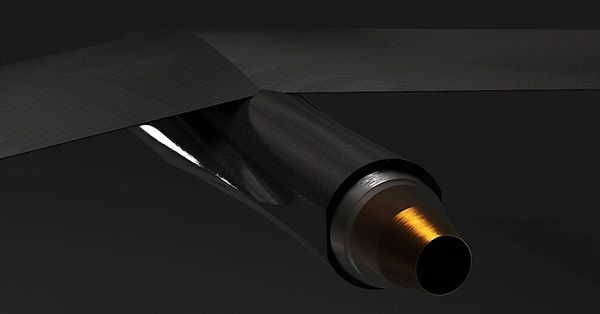
The aircraft structure is constructed entirely from carbon fiber-reinforced plastic (CFRP). CFRP offers an excellent ratio of weight to strength and stiffness, making it ideally suited for high-speed aircraft.
A turbine from JetCat is used for propulsion. Its integration places specific demands on thermal management, vibration resistance, center-of-gravity positioning, and the fuel supply system.
The goal is a reliable, integrated system that combines high performance with safe operation.
Avionics and Flight Testing
In addition to aerodynamics and structure, system integration plays a central role. Servos, control surfaces, and linkages must withstand high loads while operating with precision.
Key flight data is captured via telemetry during testing, including:
-
speed and altitude
-
temperatures
-
signal reception quality
-
turbine parameters
-
other system data
Development proceeds in stages. Prior to the first high-speed flights, the team conducts extensive component testing, structural testing, ground-based propulsion tests, and initial flight tests at reduced power.
This structured approach allows for the early identification of risks and enables technical decisions to be made based on actual measured data.
Technical Ambition
The high-speed flying wing ranks among FlightLab MUC’s most challenging projects.
It combines several disciplines of aeronautical engineering:
-
High-speed aerodynamics
-
Flight mechanics of flying-wing aircraft
-
CFRP lightweight construction and structural development
-
Precision manufacturing
-
Turbojet integration
-
Avionics and telemetry
-
Test planning and risk management
This creates a realistic development environment in which students gain insight into the entire development process of a modern aeronautical system.
The aircraft structure is constructed entirely from CFRP (carbon fiber reinforced plastic). CFRP offers an excellent strength-to-weight and stiffness-to-weight ratio, making it ideal for high-speed aircraft.
A JetCat turbine is used for propulsion. Its integration places specific demands on thermal management, vibration resistance, center-of-gravity positioning, and fuel supply. The goal is a reliable, integrated system that combines high performance with safe operation.
In the long term, the project is intended to serve as a foundation for future high-speed platforms as well as student research projects and theses.
Get Involved and Support Us
Project Corvus offers students the opportunity to gain practical experience in design, manufacturing, simulation, avionics, flight testing, and project management.
To bring this project to life, we are also seeking sponsors and partners willing to support us—for example, through financial contributions, materials, components, software, testing facilities, or technical mentoring.
Through this project, we are creating a platform where students can go beyond the theory of advanced aerospace technology to develop, build, and test systems themselves.