
AIAA Design/Build/Fly competition 2026





Our First International Competition Project
With the 2026 AIAA Design/Build/Fly Competition, FlightLab MUC carried out its first major international aircraft construction project. The goal of the competition is the complete development, manufacture, testing, and operation of a remote-controlled aircraft under competitive conditions.
Within just a few months, a student initiative evolved into a functioning engineering team that developed, built, and successfully flew its own aircraft.
The first iteration of our aircraft flew reliably and confirmed early on that our basic concept was viable. The second iteration was intended to further optimize the design for the competition. Unfortunately, a technical failure occurred during a takeoff in strong winds: the connection between the right aileron and the servo came loose, causing the aircraft to crash shortly after takeoff. As a result, we were unable to officially participate in the competition with an airworthy aircraft.
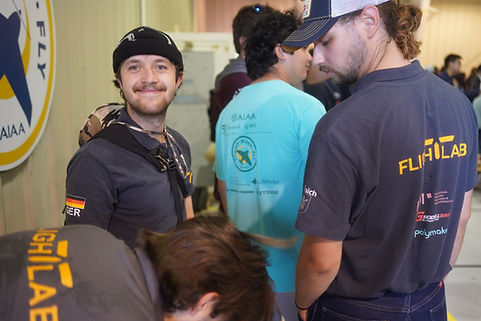
Nevertheless, our team traveled to the U.S. and participated in the competition on site. There, we were able to directly observe international teams, their aircraft, and their working methods. This experience was extremely valuable to us and forms an important foundation for future projects.
What is Design/Build/Fly?
The Design/Build/Fly (DBF) competition is organized by the American Institute of Aeronautics and Astronautics. Student teams from around the world develop a remote-controlled aircraft to meet a challenge that changes annually.
The competition evaluates not only flight performance but also the entire development process—from technical design and documentation to manufacturing quality, reliability, and the successful completion of missions.
For FlightLab MUC, DBF 2026 was the ideal introduction to international student aircraft design. The competition combines theory and practice precisely where aerospace engineering becomes particularly exciting: An aircraft must not only be designed but also fly reliably in the end.
Our Goal for DBF 2026
Our goal was to develop a robust and mission-capable RC aircraft that meets the competition requirements while also being reliably built and tested with our available resources.
We focused on three key areas:
-
Developing a functional overall system comprising aerodynamics, structure, propulsion, electronics, and manufacturing,
-
building a functional engineering team with clear responsibilities and technical processes,
-
and laying the groundwork for future FlightLab projects.
DBF 2026 was intended not only to produce a competition aircraft but also to build knowledge, structures, and experience for the long term.
From Idea to Flying Prototype
It began with an analysis of the competition requirements. Based on this, we developed various concepts and gradually refined a concrete aircraft design.
The first iteration was successfully built and tested. It flew stably and validated many of our fundamental design choices. This was a significant achievement for our young team: our first in-house prototype performed reliably in actual operation.
Building on this experience, we developed a second iteration designed to be more specifically optimized for the competition missions. At the same time, we realized just how challenging the path from a functional prototype to a reliable competition aircraft is—especially under real-world conditions such as wind, launch loads, and time pressure.
Design and Manufacturing
Manufacturing was one of the most intensive phases of the project. Real components—and ultimately a complete aircraft—were created from digital CAD data.
Depending on the specific part, materials such as wood, foam, 3D-printed components, fiber-reinforced structures, and traditional modeling materials were used. The challenge lay in finding the right balance between lightweight design, structural stability, repairability, and manufacturing effort.
For many team members, DBF 2026 offered the first opportunity to go beyond the theoretical calculations and actually build, assemble, and test an aircraft themselves—and experience it in flight.
Flight Tests and a Technical Setback
A key milestone was the successful flight of our first iteration. The aircraft flew reliably, validating the technical work carried out over the preceding months.
The second iteration was intended to bring us closer to a competitive aircraft. Unfortunately, a crash occurred during takeoff in strong winds. During the launch, the connection between the right aileron and the servo came loose, rendering the aircraft impossible to control fully.
While this failure prevented us from officially participating in the competition, it provided valuable technical lessons. It demonstrated just how critical mechanical detailing, pre-flight checks, load testing, and safety considerations are for ensuring aircraft reliability.
In aircraft engineering, in particular, small components can have a major impact. We will incorporate the insights gained from this experience directly into our future design, testing, and validation processes.
On-site at the competition in the USA
Even without officially participating in the flight events, our team traveled to the competition in the USA. There, we were able to observe international teams, their aircraft, and their operational procedures up close.
Direct comparison with other teams proved particularly valuable. Many insights are gained only on-site—during flight preparation, the missions themselves, repairs, or while managing time pressure.
We are taking these insights directly into future projects. Despite the technical setback, DBF 2026 was thus an important step forward for FlightLab MUC.
What we learned
For us, DBF 2026 was a project marked by successes, setbacks, and many valuable lessons.
The successful flight of the first iteration demonstrated that our team is capable of developing and building a functional aircraft in a short timeframe. At the same time, the crash of the second iteration highlighted just how challenging reliability is in aircraft design.
For future projects, we are taking away the following key points:
-
robust and verifiable mechanical connections,
-
standardized pre-flight checks,
-
clear acceptance criteria for critical components,
-
incremental test flights under suitable conditions,
-
sufficient time buffers for repairs and redesigns,
-
and structured project management.
These experiences will help us develop future aircraft in a more robust, structured, and professional manner.
Thank you to our supporters
A project like DBF 2026 would not have been possible without support. Materials, tools, manufacturing resources, financial contributions, and technical collaboration played a decisive role in bringing our first major competition project to fruition.
We would like to express our sincere gratitude to all sponsors, partners, and supporters who have accompanied FlightLab MUC on this journey.
Through your support, you enable students to take on real technical responsibility and work on challenging aviation projects while still in school.


